Video Description
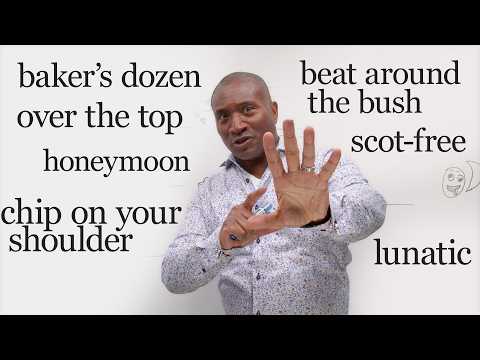
Curious why we say things like “over the top” or “scot-free”? In this lesson I dig into the odd and memorable histories behind seven English idioms and explain how those stories give each phrase its meaning. You’ll learn when to call something “over the top”, what “scot-free” originally meant (and what it means now), why a “baker’s dozen” exists, how honeymoons began (it involved getting drunk), and when to warn someone not to “beat around the bush” – all with quick example sentences you can use immediately. If you love language stories and want to sound natural in English (without guessing), this lesson is for you. https://www.engvid.com/7-common-english-idioms-origins/
More of my lessons about idioms:
5 idioms with unexpected histories https://youtu.be/WhiTdXpLK9M
8 slang phrases in English https://youtu.be/jnJHFaIPjgs
In this lesson:
0:00 7 Idioms
0:37 over the top (OTT)
1:58 scot-free
3:21 chip on their shoulder
4:39 baker's dozen
6:13 honeymoon
8:58 beating around the bush
10:24 lunatic
Transcript:
Hey, you're all bent out of shape. Hi. James from engVid. "E" is in the form of the number 7, because we have 7 cool English idioms to learn today. And I used "bent out of shape". You might not know what that means, but if the shape is straight, it's bent. But usually idioms come with a history, and are sometimes not clear to someone who doesn't know the language. In this case, English. And my job today is to teach you 7 cool English idioms, and I'll give you a little bit of history for a bonus. Let's go to the board.
All right, so the first one, you're going to see "top". Now, I used to have a British girlfriend, or a Canadian, but her father was Scottish, and he used to love to say, "That's OTT, James." And I go, "OTT", and he would say, "Over the top", sometimes known as OTT. And what does that mean? All right, you've got "top", it's over it. It means when something is excessive, or more than enough, or more than needed or necessary. Okay? You are going to the dentist, and he's going to look at your teeth, and he takes out a big, big sword to clean it. You're like, "That's excessive. That's over the top." Just a little floss. It's good. A bad example is the best one that comes to mind. This came from World War I, actually, because soldiers used to go in something called a trench. It's like a big hole, and they would be in the hole, and then they would have to get out of the hole and run across this land, and it was called No Man's Land for a reason, because when they would run, the other guys would go, "G-g-g-g-g-g-g-g-g-g-g-g-g", and shoot them. So, when they would say, "Time to go over the top", the soldiers would be like, "This is a bit excessive, a bit much. We're going to get shot." Right? So, when you tell someone it's "OTT" or "over the top", you're saying it's too much. Cool? It's the first one. See, it's cool. I told you right away.
What about this one? Everybody loves tax-free. Well, I've got a little something to tell you. This one is going to be called "Scot-free", and some of you might say, "Scot-free? Is that a name? It's, like... It seems, like, Scottish. Right? And free?" This is from Old English, from medieval times. Medieval times is, like, you know, when the king and queen 400 years ago, maybe 16th century, right? The British used to tax people, and the tax... A word for "tax" was called "scot". Okay? Now, if you didn't have to pay the taxes or you got away from paying the taxes, it was called "scot-free", and people would try to get scot-free. Now, in the modern time, we took that same idea, and what we say today when we say "scot-free", it's not about being tax-free, it means when you've done something bad-okay?-but you don't get in any trouble. No trouble. You get away with it. Ha-ha-ha-ha-ha. We now say, "You got off scot-free." So, sometimes people go to, you know, see a judge, and the judge goes, "Okay, you killed 10 people and ate 7 of them, but there's no video evidence because we don't have cell phones." So you can go, "You got off scot-free." Okay?
Number three, "chips". If you're from England, it's called "crisps". Now, in the 18th century in America, young boys, or 18th, 19th century young boys would take a chip. Now, a chip would be a wood chip. Okay? So not chips or crisps, but a little piece of wood. And when they wanted to fight, they'd put that chip on their shoulder, and they'd walk around like this, and they would say, "I dare you to knock it off, because if you knock it off my shoulder, we're going to have a fight." And they would walk around all day going, "You want to fight? Knock off the chip." Over time, we don't walk around with chips on our shoulders, but when we say somebody has a - sorry - a chip on their shoulder, we're saying they're looking for trouble, they want to fight. […]