Video Description
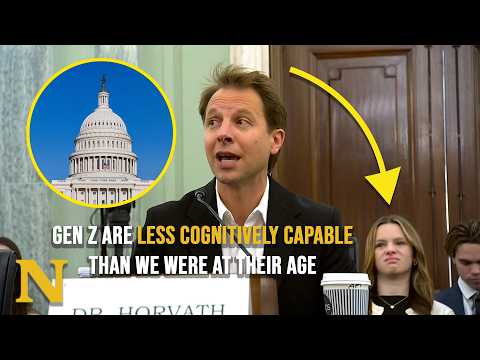
Former teacher and cognitive neuroscientist Dr. Jared Cooney Horvath
testified before the U.S. Senate Committee on Commerce, Science, and
Transportation — and his opening line stopped the room:
"Our kids are less cognitively capable than we were at their age."
For the first time in modern history, Gen Z is underperforming their
parents on every cognitive measure — attention, memory, literacy,
numeracy, and IQ — despite spending more time in school than any
generation before them.
Drawing on 60 years of research and over 20,000 studies, Dr. Horvath
makes the case that screens in schools aren't helping learning.
They're actively harming it.
⏱ CHAPTERS
0:00 — Opening statement
0:53 — What changed around 2010?
1:32 — The data across 80 countries
2:00 — 60 years of academic research
2:57 — Two options going forward
3:14 — The SAT reading test story
4:16 — Final warning to the Senate
-
Newsner.com — Real Rescues & Everyday Heroes Caught on Camera
Welcome to Newsner.com — your daily source for the world's most powerful real rescue videos, hero moments, and acts of kindness caught on camera. From firefighters saving lives to strangers helping strangers, we bring you the true stories happening right now across the globe.
Watch real people doing extraordinary things — brave rescues, emotional reunions, and small acts of kindness that ripple into something bigger. These aren't actors. These aren't scripts. Just real moments, real people, and real courage — filmed as it happened.
Every day we share new videos from around the world that will move you, inspire you, and remind you what humans are truly capable of. Whether it's a dramatic ocean rescue, a community coming together, or one person making a difference — you'll find it here.
Subscribe to Newsner.com and never miss a story that matters.
Subscribe to our channel so you don't miss the next story: https://www.youtube.com/channel/UCYCxYp7o8PZuer5vTGzuEUg
Follow us on:
📘 Facebook: https://www.facebook.com/newsnercom
📸 Instagram: https://www.instagram.com/newsnercom
🎶 TikTok: https://www.tiktok.com/@newsnercomofficial
In this video, a cognitive neuroscientist discusses a concerning trend: a decline in cognitive capabilities among the current generation of children compared to previous ones. This observation, rooted in cognitive science, suggests a correlation between the adoption of digital technology and a decrease in brain function, potentially leading to memory loss and cognitive impairment. He advocates for a return to analog methods to support healthier brain development. 🧠