Video Description
Primitive Technology: Water Bellows (uses water instead of leather)
Subscribe: http://bit.ly/subPT | Never miss a video! Enable ‘ALL’ Notifications!
Watch my newest content: https://youtube.com/playlist?list=PLGnWLXjIDnpBR4xqf3FO-xFFwE-ucq4Fj&playnext=1&index=2
Follow Primitive Technology:
Wordpress: https://primitivetechnology.wordpress.com/
Patreon: https://patreon.com/user?u=2945881
Watch More Primitive Technology:
Newest Uploads: https://youtube.com/playlist?list=PLGnWLXjIDnpBR4xqf3FO-xFFwE-ucq4Fj&playnext=1&index=2
Pyrotechnology: https://youtube.com/playlist?list=PLGnWLXjIDnpBVRqu5lz5JGaQxjPs7q3CJ&playnext=1&index=2
Shelter: https://youtube.com/playlist?list=PLGnWLXjIDnpBBsdKZb-vy30o88SIxItp2&playnext=1&index=2
Weapons: https://youtube.com/playlist?list=PLGnWLXjIDnpA-XGDrrmVgBnSXx15i2Awp&playnext=1&index=2
Popular Videos: https://youtube.com/playlist?list=PLGnWLXjIDnpAb29Lrdki5BPjTpMon8zla&playnext=1&index=2
About This Video:
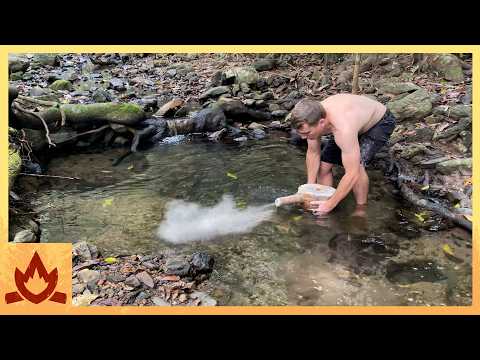
I built a Water Bellows. It’s an upside-down clay pot with an inlet valve and an outlet spout. The inlet valve is simply a hole in the pot with a leaf plastered to the inside with wet clay so that it forms a one-way flap valve. When pushed down into water, the valve shuts and air is forced out of the spout and into the fire. When the pot is lifted in water, air is sucked in through the open inlet valve and the cycle repeats.
I got the idea from a Food and Agriculture Organization website I saw years ago. A Google image search for “FAO water bellows” gives an image of someone using a more complicated version at a brick forge in Zimbabwe, possibly from 1994, but I can no longer find the original diagram or description. From memory, the air and water containers were steel drums and there was a U-shaped pipe to convey the air down from inside the air drum when lowered, through and out the water drum and into the fire. Air entered an inlet valve in the top of the air drum when lifted. There may also have been an outlet valve which would presumably have been located on the outlet pipe. The pipe remained stationary through the cycle.
My design is a simplified version of this with a spout leading directly from the air pot into the fire. The spout moves with the pot instead of being fixed in place as it is raised and lowered. The spout nose is resting in place on the ground in front of the fire acting as a hinge, with the whole unit acting as a lever. If the nose of the spout is resting in the entrance of a fixed tuyere (air pipe) then the angle of the jet can be kept constant with the added advantage of the venturi effect drawing in more air. My design also only has one valve (inlet) for simplicity.
The bellows produced a similar effect to the traditional blacksmith bellows without requiring leather to build. It seems to produce a higher-pressure jet of air than the blower I’ve used previously. It’s also less complicated to build, with fewer perishable materials and has fewer moving parts that often break or seize during use. It should be easier to maintain, more ergonomic and require less skill to use. My next step is to conduct a test iron smelt with the existing prototype and compare its performance with the old blower. Possible improvements could be made where it would be made a double acting bellows with two connected pots similar to the Peruvian whistle jar but with 4 valves to direct air flow. It could also be made larger or two could be used at the same time.
About Primitive Technology:
Primitive technology is a hobby where you build things in the wild completely from scratch using no modern tools or materials. These are the strict rules: If you want a fire, use a fire stick - An axe, pick up a stone and shape it - A hut, build one from trees, mud, rocks etc. The challenge is seeing how far you can go without utilizing modern technology. I do not live in the wild, but enjoy building shelter, tools, and more, only utilizing natural materials. To find specific videos, visit my playlist tab for building videos focused on pyrotechnology, shelter, weapons, food & agriculture, tools & machines, and weaving & fiber.
#PrimitiveTechnology #WaterBellows #claypot