Video Description
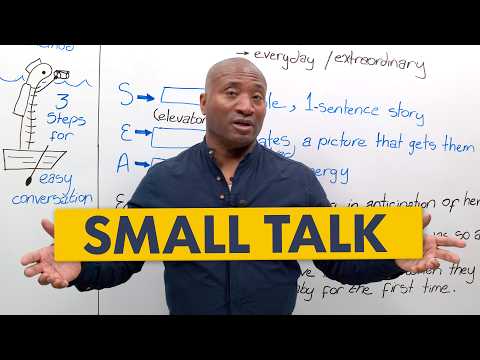
Want to improve your small talk and have better conversations in English? In this lesson, I’ll teach you the S.E.A. Method—a simple, three-step formula that makes small talk easy, natural, and engaging. Learn how to tell short, emotion-filled stories that grab attention and make people want to keep talking to you. Whether you’re shy, learning English, or just want to improve your social skills, this lesson will help! Watch now and start using this method in your everyday conversations. https://www.engvid.com/have-better-conversations-sea-small-talk/
Next, check out more of my videos about small talk:
3 Keys to Small Talk https://youtu.be/gbfV0b8Tn0A
Conversation Skills: 5 questions to make you the most interesting person in the room https://youtu.be/hOXNssFPEnM
My full playlist of videos about how to have great conversations: https://www.youtube.com/playlist?list=PL1MxVBsQo85qo3qUIS4W1us13EnDt8nVA
In this lesson:
0:00 Use the S.E.A. method for better small talk
3:02 1. Simple
4:49 2. Emotion
6:16 3. Action
8:28 Examples
13:57 Conclusion
TRANSCRIPT:
Hey, look. E on the sea. He's a seaman. He's got a little boat. I think he's in the American Navy. He's got his little cap on. Why is he on the sea? Well, today is a specific method working on small talk. You might be thinking, "What is small talk? Why is it important? I need to do big conversations and big presentations, and I need to make friends, and I want to get a partner. All of these involve big talk or a lot of talk, serious talk." I got to tell you a little secret, and the secret is this. Anything that goes big starts out from something small. Small talk is the talk that you have with someone that gets them interested in you to want to have more conversations.
Now, if you're an introvert and you speak English, this is something we need to work on as native speakers, but if you're also a language learner learning English, small talk is your way to get into these larger conversations because someone who's really good at small talk invites bigger, better conversations because the people think you're capable of them. Okay?
Now, E, we got the SEA method, right? S-E-A method, and there's three steps for this which leads to an easy conversation for you, good conversation starter, or how to go from one conversation, small one, to a larger one. Excuse me. What I want to address is how we're going to use our small talk. There's many different ways of getting to small talk, asking questions about something someone's wearing and other things. Today I want to really focus in on stories. Why stories? Because stories, humankind, mankind, people have for thousands of years sat around fires, you know, you can imagine there's a fire, the cold's going up and the people sitting there, it's dark at night, and they hear "Woo-hoo", the wolves, so they're in a circle, huddled, you know, holding together, and then someone would tell a story. "A long time ago when the great moon came down, and our fathers", and it brought the people together. So, stories create connection, bringing different people together.
The other thing about stories, when we tell stories, we can take the everyday, and I meant it this way, the everyday means regular day, not every day, Monday, Tuesday, but your regular day, and we can make it extraordinary. Because in a story, you take an everyday event, and we take a regular person and we make them special. Now, when you do that in small talk, you make the person you're speaking to feel special. Now, how are we going to do that? Well, we have three steps, and as you can see, we're missing them, but I'm going to fill them in and explain them to you so you will be able to start making your own stories and making the everyday extraordinary with small talk. You ready? Let's begin.
The first one you see here is "S", right? It's an acronym... "C" is an acronym for three words. The first one is "S", and after it says simple one-sentence story. Well, if you have a simple one-sentence story, it's going to be short. And how short is it? One sentence. We don't want to make it too long. Why? You're learning about language. You're already having a hard time, you're nervous using this language, talking to people, so if you have a big story in your head and you make mistakes and you're getting it wrong, what's going to happen is you get more nervous and you might forget parts of the story and you're going to lose the person's interest. So, why don't we make a story very, very short? In marketing and advertising, they call this type of thing a "elevator pitch", and if you're wondering what an elevator pitch is, you know when an elevator moves at a certain speed going up or going down, and they would say you should be able to tell your story between the floors. […]