Video Description
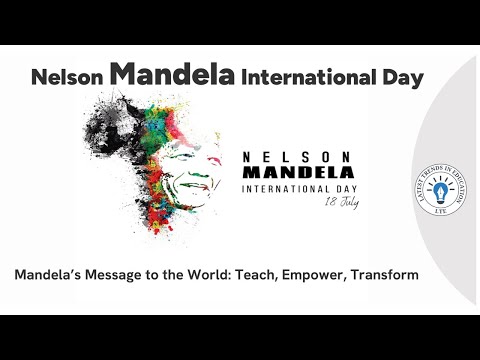
He spent 27 years behind bars, yet emerged not with bitterness, but with a vision: a nation where education empowers, not divides. Nelson Mandela believed that classrooms are battlegrounds for justice, and that every book, every teacher, every student holds the power to rewrite history. On this Mandela Day, we remember a man who taught the world that true freedom begins in the mind — and that education is the key to unlocking it.
Nelson Mandela once said, 'Education is the most powerful weapon which you can use to change the world.' His life proved those words true. From village schoolboy to global icon, from prison student to president, Mandela showed us that knowledge is not only power — it is hope, healing, and revolution. Today, we honor his legacy by standing for equal education, ethical leadership, and the unwavering belief that learning can liberate us all.
“Education is the most powerful weapon which you can use to change the world.”
This quote has become a guiding principle for educators globally. Mandela believed that education was essential for breaking the cycle of poverty, dismantling apartheid, and building a democratic and equitable society.
“Education is the great engine of personal development. It is through education that the daughter of a peasant can become a doctor, that the son of a mine worker can become the head of the mine, that a child of farmworkers can become the president of a great nation. It is what we make out of what we have, not what we are given, that separates one person from another.”
Nelson Mandela’s quote highlights the transformative power of education as a force for personal growth and social mobility. He emphasizes that education is not just about acquiring knowledge, but about unlocking human potential — regardless of one’s background or circumstances. By pointing out how children from humble beginnings can rise to positions of influence and leadership, Mandela affirms that where we come from does not define where we can go. The final line — “It is what we make out of what we have...” — is a reminder that determination, effort, and education are what truly separate individuals, not privilege or status. It’s a call to invest in learning as a pathway to justice, equality, and self-empowerment.
“Young people must take it upon themselves to ensure that they receive the highest education possible so that they can represent us well in future as future leaders.”
Nelson Mandela’s words are a powerful message of responsibility and empowerment directed at youth. He reminds young people that education is not just a personal privilege, but a collective duty — a way to prepare for the role of shaping the future. By encouraging them to pursue the highest education possible, Mandela emphasizes that leadership begins with knowledge, discipline, and self-motivation. The quote reflects his belief that today’s students are tomorrow’s decision-makers, and that the future of a nation depends on how seriously its youth invest in their learning today.
How Teachers Can Be Inspired by Nelson Mandela in the Age of AI & Digital Literacy
1. Use AI and Technology as Tools for Equity — Not Division
? Mandela’s message: “Education is the most powerful weapon which you can use to change the world.”
2. Teach Ethical Responsibility in the Digital Age
? Mandela’s message: “To be free is not merely to cast off one’s chains, but to live in a way that respects and enhances the freedom of others.”
3. Model Lifelong Learning and Resilience
? Mandela’s example: Even in prison, he never stopped learning — proving that education is a lifelong journey.
4. Lead with Purpose and Humanity in the Digital World
? Mandela’s ethic: Leadership rooted in humility, empathy, and service to others.
5. Inspire Courage and Critical Thinking
? Mandela’s message: “I have cherished the ideal of a democratic and free society...”
@latesttrendsineducation