Video Description
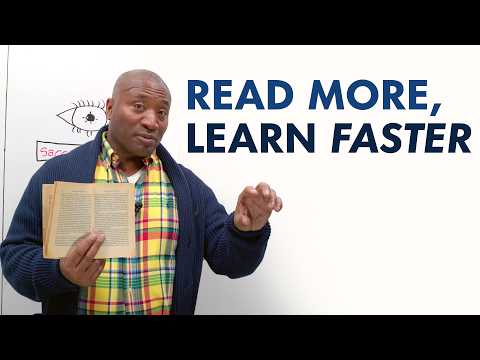
Did you know READING can speed up your LEARNING? In this lesson, you’ll learn how to improve your English speaking, listening, and writing skills – all through reading! I’ll explain the techniques of smooth pursuit, subvocalization, and sustained reading. You’ll learn exactly how reading helps you recognize, hear, and understand words faster. Watch and become a smarter English learner today! https://www.engvid.com/improve-your-english-faster-by-reading/
Next, check out more of my videos about learning English faster!
From Vision to Action: My 3-Book Formula for Success https://youtu.be/HRQHIdUmvQw
3 Mental Methods to Learn English Faster https://youtu.be/-YTBQH_bPD8
In this lesson:
0:00 Improve your English by READING!
0:48 Saccades
2:51 Smooth pursuit
4:39 Subvocalization
6:26 Sustained
13:29 A special reading trick
TRANSCRIPT:
Doo-doo-doo-doo-doo-doo Hey, E. What's the topic for today? Ah... Ladies and Gentlemen, today I will be presenting to you a secret not known by many people called reading. And you're going to say "What is the secret?" Well, this is the key to help you learn language faster. Surprising, because most people think: well I should talk more, get more talking practice, and I need to get vocabulary, and I need to listen better. And I need to learn how to write! And I'm going to show you today, with the help of magical E -- he's looking surprised because he doesn't want to be involved -- don't know why, you have a book! How this is going to help you with this, this, and this. Let's go to the board.
The first word I'm going to teach you is a word not many people know, but you have to understand: this is an important factor of how our eyes work. So I'm going to use some language that might be really high. I'll explain it. And just be patient. You're going to learn a lot... about you, and improve your language skills at the same time. Saccades. "Saccades" is what I'm going to say. It could be "saccades". This is what we call the way the eye moves. You see, when we look at things in nature, and this is important, because reading isn't natural. There are no books in nature. There are birds, and trees, and cars. Our eyes were designed to look, look, look, look, look, look, look. It kept us alive, because if I just kept looking ahead, a tiger could come and eat me. So, my eyes would look, look, look, look, look, but I would see everything. Now, a saccade is kind of a fixation. Our eyes jump, and a fixation means to stay in one place, but our eyes jump around. Now, if you think about a book, a book has lines, and if you jump around, that makes it very difficult to see. So, we're going to, with our understanding now what a saccade is, we're going to learn to train that to help you with reading. You know, okay, well, how does this help with language? Hey, grasshopper, one step at a time.
Now, reading is interesting. You might have noticed I mentioned vocabulary, and many students say to me, "Oh, I need vocabulary." Here you go, vocabulary on the go. There is one little trick that makes all of this work, so I'm going to mention it now and at the end. You must pick material for this to work that you know at least 85% of the vocabulary. So, don't pick up a book on physics if you don't read physics; this will not be helpful. So, saccades are how our eyes move. A little uncontrolled, they jump around. And you may have noticed this when you're reading, sometimes you're reading and you go, "Oh, where was I?" Because your eye has jumped.
So, the first trick I'm going to teach you, see, this is three S's, and if you want to know what the three S's are, smooth pursuit, sub-vocalization, and sustained. And I will explain each one for you now. Well, smooth pursuit is this. Yeah, some of you are going, "What are you doing?" But you followed my finger, didn't you? You notice my finger did not do this; it went like this. Well, if we can control the saccades, we can control how we read, and it makes it much easier for us to learn. Why am I starting with this for language learning? Well, you're not going to read the book, and most people don't read, to be honest, because it takes too long. And now you understand if your eyes are jumping around, that makes it worse, especially if it's not your language. We're going to use the idea of smooth pursuit, which is using our finger or a pencil to move across a line to help us focus. That focus will actually turn our brains on so we can learn more. So, the first secret I'm going to give you is use your finger for smooth pursuit to move along the line to keep you focused, so you can keep the ideas in your head. That's number one. And in doing this, because you stay on the line, it will help with vocabulary, because in many English sentences we do... We use synonyms. We'll use one word and a little later use a different word to keep your interest, so you're actually picking up on vocabulary. […]