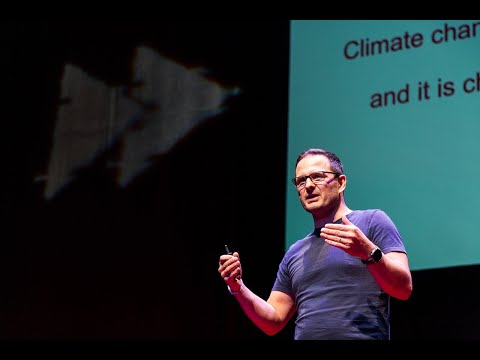
Video Description
A cracked riverbed, a drought, people on the move — and the headline writes itself: climate change breeds war. Florian Krampe has spent his career in the places that story is told about, and he thinks it's not just lazy but dangerous. It turns people into "dominoes waiting to fall in a warming climate," strips them of agency, and quietly excuses us from looking at what actually drives violence. The threat he documents is real — water weaponized, wells destroyed, even dams seized — but the easy climate-conflict narrative, he argues, misreads it.
His sharpest warning is for the people who show up to help. Sent to fix a water dispute in a divided city, the international community treated it as a plumbing problem and "solved" it — and made the conflict permanent instead. In fragile places, he says, water is never just water; it's power, legitimacy, and identity, and the well-meaning technical fix can harden a division into concrete and pipes. Why do good intentions so often boomerang?
The turn is hopeful, and it's the part worth staying for: cooperation over scarce resources turns out to be far more common than conflict, and the same environment we fear as a trigger for war can become, in his words, "an unseen architect of peace." Krampe has watched it happen on the ground. His real claim is that the future isn't written by the climate — it's written by the story we choose to tell about it, and he's asking which one we'll pick. Dr. Florian Krampe is a Swedish-German political scientist specializing in peace and conflict research, environmental and climate security, and international security.
Florian Krampe is the Director of Studies for Peace and Development at the Stockholm International Peace Research Institute (SIPRI) and Director of SIPRI’s Climate Change and Risk Programme. His research focuses on the interlinkages between climate change, security, and peacebuilding, with a particular emphasis on the ecological foundations for sustainable peace and the governance of renewable natural resources in post-conflict societies.
Since joining SIPRI, Krampe has advised policymakers across multiple UN agencies and bodies, including the UN Security Council, the Department of Political and Peacebuilding Affairs (DPPA), the UN Peacebuilding Commission, UN Development Programme (UNDP), the UN Environment Programme (UNEP), The World Food Programme (WFP), and the Food and Agriculture Organization of the United Nations (FAO). Krampe equally engages with a range of regional organizations such as the African Union, Organization for Security and Co-operation in Europe (OSCE), NATO, and the European Union. He regularly provides expert input and policy advice to governments, including Germany, United Kingdom, USA, Canada, Sweden, Norway, Finland, Denmark, Switzlerland, South Korea on the interlinkages of climate, peace and security.
Krampe is an Affiliated Researcher at the Research School for International Water Cooperation at the Department of Peace and Conflict Research, Uppsala University. He served as a Specially Appointed Professor at the Network for Education and Research on Peace and Sustainability at Hiroshima University, Japan. From 2014 to 2016, he was Director of the Forum for South Asia Studies at Uppsala University, an interdisciplinary initiative supporting research on South Asia in the humanities and social sciences. This talk was given at a TEDx event using the TED conference format but independently organized by a local community. Learn more at https://www.ted.com/tedx