视频说明
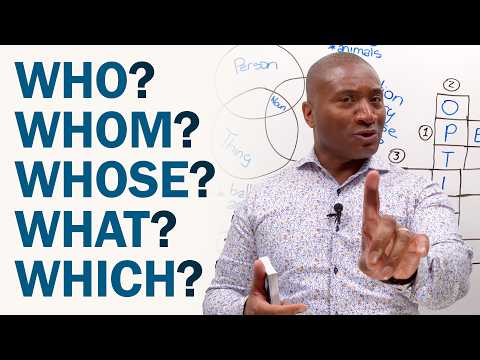
Learn when to use “who”, “whom”, “whose”, “which”, and “what” with clear rules, examples, and quick tricks for asking better questions in English. In this lesson I break down the five main interrogative pronouns – who, whom, whose, which and what – and show simple rules and natural examples so you stop guessing and start asking questions correctly. I explain the difference between subject and object (so you’ll know when to use “who” or “whom”), how to ask about possession with “whose”, and the fast ways to decide between “which” and “what” in conversation and writing. You’ll also learn about using words like “whoever” and “whatever”. And finally, we’ll practice together with a little test. https://www.engvid.com/5-english-interrogative-pronouns-who-whom-whose-which-what/
Watch more of my grammar lessons:
Advanced Prepositions of Time: THROUGHOUT, AHEAD OF, AT AROUND, OUT OF… https://youtu.be/R1pzn5dS4_o
How To use Subordinating Conjunctions for Better English https://youtu.be/Sre8LBYJP4g
In this lesson:
0:00 The 5 Main Interrogative Pronouns in English
1:28 What is a noun?
3:57 Are animals things?
6:02 When to use interrogative pronouns
8:25 who
9:30 whom
10:37 whose
12:32 which
14:06 what
17:07 whoever, whomever, whatever...
18:42 Quiz
23:08 Homework
Transcript:
Whoa, that looks bad, James from EngVid. He looks like he's broken. Hey, what happened to you? Which fool did this to you? Who was it? Now, right there, I've started the lesson already. I want to introduce to you interrogative pronouns. These are words that we use to replace nouns in speech when we want to ask a question. Now, if you're an advanced student and you're about to run off, don't. Hold on a second. I'm going to try and give you a little bit more so it'll be good for you. And if you've learned English on your own, as in self-study, this should be good for you. And if you're a beginner, buckle up, put your seatbelt on. Might be a little tough, but we're going to get there.
Now, why this particular lesson? Because I'm going to start with something very basic about what a noun is, and I'm going to move to how we shift from nouns to ask questions about nouns, and specifically about things we don't know. Right?
So, there's three words I want to teach you, and it might be a little confusing part, but I'll make sure it's clear because there's going to be a second part to this that'll give you more information about interrogatives. An interrogative is a question form. Okay? And today we're going to deal with the pronouns, and we're going to deal with the three top pronouns. Okay? And their variations. Give me a second. I'm going to go to the board.
So, what is a noun? A noun is typically three basic things. It is a person, a place, or a thing. And you noticed I did a Venn diagram to show how eventually all three things, if you have all three, they're nouns. Now, what's a person? It's a human, like you and me. Right? Okay, well, you're human, I'm a freak. But it's a human, and that could be a man, a woman, a boy, and a girl. You'll notice I have animals up here, and I'm going to come back to that. All right? Because depending on where you live in the world, I don't think you think man, woman, dog as human. And you're right, but there's an exception. The next thing we're going to look at for what is a noun is a place. A place can be at location, anywhere. It can be a country. What country do you live in? Right? It could be a house. That's a place, or a school. And Mars. Some people want to go there. Anyway. And then the thing, and a thing is when we can't talk about... Because we live in the real world. Right? And in the real world, we see people, talk to them, "Hey, how you doing?" We go to places. But then there's this other thing, and I just used the word "thing", where it's not a person, not a place, but an object. And sometimes it can be a rock or other things, so we just kind of go, "Thing". And these could be balls, you know, like soccer balls, if you play soccer. Yeah? You like playing soccer? They could be animals. You know, bears, tigers, cats, dogs. Or they could be ideas, like democracy, economics, philosophy. These are mental. These are in your head. They're not things you can actually touch, but they are things. And we throw many things under "things" because if they're not people or places, it's sort of like you go, "Think!" But we say these are things in the world. Okay. There's your basic lesson, so if you've never done English grammar, this is one of the things you have to learn. You know, what are nouns? Because we use them to identify, to give structure to sentences, which will be another lesson. Okay? […]