视频说明
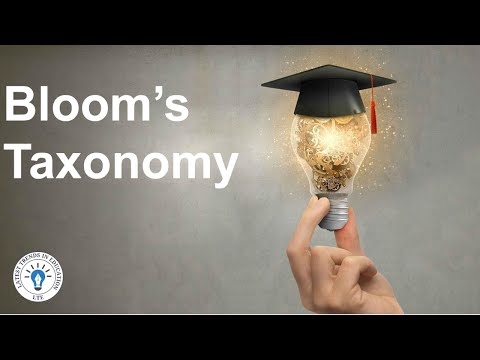
Bloom’s Taxonomy is a framework developed in 1956 by educational psychologist Benjamin Bloom and his colleagues to classify educational goals and objectives. It provides a structured way of thinking about learning by dividing cognitive skills into hierarchical levels of complexity. Originally, it included six levels: Knowledge, Comprehension, Application, Analysis, Synthesis, and Evaluation. In 2001, a revised version reordered and renamed these levels to: Remember, Understand, Apply, Analyze, Evaluate, and Create.
The purpose of Bloom’s Taxonomy is to help educators plan and assess learning more effectively. By understanding how students move from basic recall of facts to more complex levels of thinking like analysis and creation, teachers can design lessons that support deeper learning. Each level of the taxonomy builds on the previous one, encouraging students to develop higher-order thinking skills rather than just memorizing content.
In practice, Bloom’s Taxonomy is often used when writing learning objectives or lesson plans. For example, a teacher might set a goal for students to "describe" (Understand level) a scientific concept, and later "design an experiment" (Create level) based on that concept. Using action verbs aligned with each level helps clarify the expected outcomes and ensures the learning activities target different types of thinking.
Assessment and questioning strategies also benefit from the taxonomy. Teachers can vary the cognitive demands of their questions by including lower-level tasks (e.g., "List the main causes of World War I") as well as higher-level ones (e.g., "Compare the causes of World War I and World War II"). This allows educators to check both surface understanding and deeper comprehension or critical thinking.
Ultimately, Bloom’s Taxonomy is a powerful tool for enhancing curriculum design, teaching, and assessment. It supports a holistic approach to education by encouraging the development of not just knowledge, but the skills needed to apply, evaluate, and create based on that knowledge. Teachers can use it across all subjects and grade levels to promote more meaningful and engaging learning experiences.
@latesttrendsineducation