视频说明
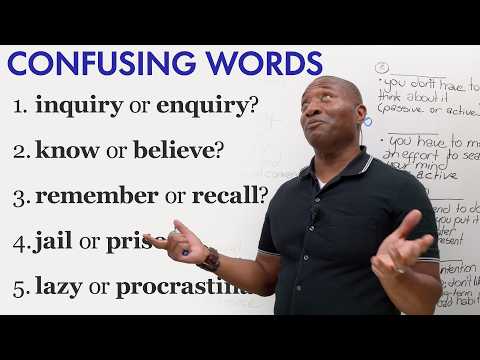
Speak more precisely—learn the difference between these five pairs of English words that seem similar. We will look at: *“inquiry”* & *“enquiry”, “jail”* & *“prison”, “remember”* & *“recall”, “procrastination”* & *“laziness”,* and *“knowledge”* & *“belief”.* If you want to sound more precise and confident in English, understanding these distinctions will make a big difference. Test your knowledge with the quiz: https://www.engvid.com/confusing-english-words-remember-recall-more/
More of my videos about commonly confused words:
https://youtu.be/p1DwCT5F9PI
https://youtu.be/hQGGXZFB5Ow
In this lesson:
0:00 11 Confusing Words in English
0:23 "inquiry" or "enquiry"?
2:41 "knowledge", "belief", or "faith"?
6:52 "jail" or "prison"?
9:37 "procrastinate" or "lazy"?
12:52 "remember" or "recall"?
Transcript:
I have a lesson for you today about some commonly confused words, not just by people learning English, but by native speakers. They will use these words, and I've done this myself. In fact, one of the words I'll show you, and until I did this lesson, I didn't have a way to remember or remind myself how to tell the difference. And you know what? Let's go to the board. Enough waffling. Let's go to the board.
So, okay. The first word is - well, it's interesting. This word is used in both countries, but in one country, England, in British English, they use two different things to identify it differently, while in North America, especially the United States, let's just say, they use one word. Now, it's this word. To inquire. Or, actually, the word I want to give you is this one, so I'm just going to erase that. Sorry about that. But an inquiry. So, when they have an inquiry, it's like a question. They have an inquiry, I have a question. That's it. And they use this for formal and an inquiry. For formal things, like when their government is looking into something they think is bad, they do an inquiry, or they're at court or trial, they do an inquiry. But they use the same word for casual conversation. Now, the British don't like that, not at all. They separate the words. Now, they have an inquiry for formal investigations, so a police investigation, a government investigation, but when they talk and they have a question, like I have an inquiry, an inquiry, they go like this. They inquire. They change... Oops, sorry. I got my word, here. They change the word. So then they have an inquiry, also with a "y", but they change it to "e". I don't know why the British started it off, but the Americans went, "Why we got to say two? One will do." Okay? Both of them mean to ask a question, but you will find in America for the casual, inquiry is used, while in Britain, formally they use inquiry, but they inquire or have an inquiry when they're talking casually. So keep that in mind. Okay? So, you notice where I have "investigation", and that's how you'll tell the difference. When you look at "investigation" for both countries, for formal investigations it would be "in", and with the "e" for British English, it will be "casual". Okay? So that's your first confused words, because I live in Canada and we actually use both, but in the United States they only use the one. All right?
Now, my next word, there's three of them for "be", so we got... We have to ask a question. What are the three? Well, this is something that most people in North America, they just throw these words around. The last one, not so much, it's understood to be very special, but the first two are just thrown around and understood to be almost the same. You might go, "What's he talking about?" Well, I believe you'll understand once I write it out. So let's do the first word. "Know". "Know" comes from the word "knowledge" or "gnosis", well, "gnosis" is a little different, but "knowledge", and it's based on facts, proof and verification. What does that mean? When you know something, you can prove the facts for it, but not just facts, you can get proof. Like, I can show you this, show you this, verification. Other people, like scientists, they test it to make sure, so not only do I think it, Tommy is testing it so we know it's a fact. That's how we know. A lot of people do this, though. Sorry, they think this word and this word are the same. They have beliefs. They think, "Well, if I believe it, it must be true." "Know", and here's why they think these two are the same, and I'm teaching you these words to be accurate and precise in your language because it demonstrates a deeper understanding. All right? And when people speak to you, you can understand, especially if you do know what these words mean, it changes what I say. Okay? For example, when you have a belief, it's based on your personal experience, like, this has happened to me, so I know it's true because it's happened to me. Notice the word "verification" is used here. […]