视频说明
Try 2 weeks free of the BWS+ App and use code checkout for 10% off your first year:
https://bws.plus/4a
Check out the pre-print of the study here:
https://sportrxiv.org/index.php/server/preprint/view/660/1446
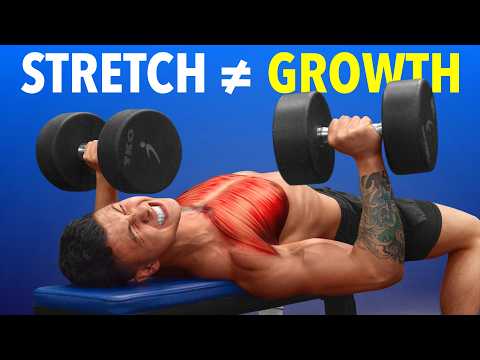
In the past few years, everyone in fitness has become obsessed with lengthened muscle training (or stretch mediated hypertrophy). They all believed it was the fastest way to gain muscle. Including me. We told you regular curls and lateral raises weren’t enough, and that if you weren’t doing these fancy “S-tier” movements designed to hit the stretch the hardest, you were leaving gains on the table. But the more I looked into it, something felt off. So I spent over $40,000, brought in custom machines, and ran one of the most comprehensive MRI studies ever done to answer one question: is the stretch really the key to build muscle faster and more muscle growth?
THE LENGTHENED MUSCLE TRAINING HYPE
We’ve actually known about the benefits of stretching a muscle for growth since the 1970’s, starting with researchers hanging weights from the wings of chickens so their lats were stretched and growing them by 170%. Then came extreme loaded stretching in humans for the chest and calves, where stretching alone led to almost as much growth as normal strength training. Researchers tried to transfer these “stretch benefits” into normal training by comparing exercises like tricep pushdowns vs overhead extensions, and different leg extension positions, where deeper stretch often led to more growth. That’s when the trend exploded: stretch-focused training became the answer to everything.
THE GAPS IN STRETCH MEDIATED HYPERTROPHY RESEARCH
I realized there were three serious gaps in the research no one was really talking about. First, almost every study showing that training in the stretch helps muscle growth has been done on the biceps, quads, or calves — muscles that are easier and cheaper to test, but don’t stretch or behave like everything else. Second, many of these studies compare totally different exercises, like preacher curls versus incline curls, where the “better” one also locks you in place and reduces cheating, so it’s hard to say if the growth came from the stretch, the stability, or both. Third, most of the research uses ultrasound, which only provides a snapshot of thickness at certain points and can’t see that muscles don’t grow evenly from top to bottom — a big issue when we’re trying to understand “stretch” effects.
THE STUDY
To fill these gaps, I teamed up with my local university and some of the smartest minds in the field, including Bret Contreras and Kassem Hanson. We chose muscles that rarely get studied for stretch — chest, glutes, side delts, and rear delts — to see if the muscle growth benefits that showed up in quads, calves, and biceps would hold up. Because these exercises can’t be measured properly with ultrasound, we used the gold standard: MRI. Prime Fitness USA built custom machines for lateral raises, hip extensions, pec flyes, and reverse flyes, where a simple turn of a knob let us make the exact same exercise hardest in the stretch or hardest in the squeeze. We recruited 20 men and women, used a within-subject design so one side did “stretch-focused” training and the other “squeeze-focused”, blinded the analysis, and hit 97% adherence, with most people’s muscles growing by around 20% in just 10 weeks.
THE RESULTS
So which side grew more, stretch or squeeze? After all the money and a year of work, the results were: every single muscle grew the same amount on both sides. There weren’t even trends suggesting one side helped build muscle faster. I was honestly shocked.
WHAT THIS MEANS
“The stretch” everyone talks about isn’t just one thing — it’s three ideas getting mashed together. First is the degree of stretch: some bi-articulate muscles like hamstrings, quads, calves, and triceps cross two joints, can stretch further, and consistently grow faster when you load them more in that stretched position. Second is range of motion: the stretched position, often the bottom of a movement, tends to be most important for growth, so cutting your reps short will limit your gains. Third is the resistance profile: whether a lift is hardest in the stretch or in the squeeze. Our study tested that last piece and found that, as long as you’re using a full range of motion and there’s at least some tension in the stretch, it doesn’t seem to matter if the hardest part is at the bottom or the top. Some muscles, like calves, still seem to respond especially well to stretch-focused work, and for bi-articulate muscles there’s good reason to include extra-stretch options.
But overall, these results suggest there’s a much wider range of exercises that can be effective for growth (I.e., stretch isn’t the fastest way to gain muscle) as long as you’re training hard, not cutting your range of motion short, and staying consistent.