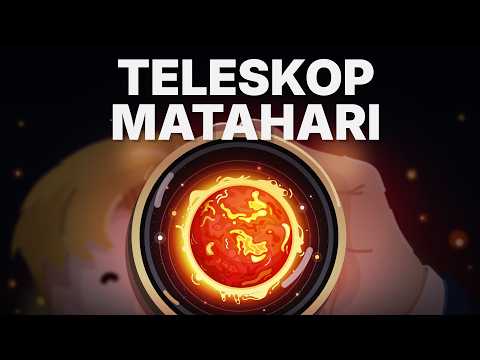
Ratusan tahun lalu, foto bulan kita masih burem. Sekarang, teknologi udah makin maju sampe kita bahkan bisa ngeliat “pori-pori” permukaan Bulan! Tapiii sayangnya teleskop kita masih burem kalau dipake buat ngeliat planet di galaksi tetangga. Ya, kita butuh teleskop yang lebih canggih lagi! Daaan ada satu ide gila buat ngebikinnya: manfaatin matahari~ Oke, gimana bisa? Enjoy the video!
---
Tanyakan pertanyaan aneh anda di sini! NGGA ada pertanyaan yang bodoh! 'Kok Bisa' ngga cuma sekedar mencoba menjawab pertanyaan-pertanyaan yang terlihat bodoh, aneh dan dungu di sini, tapi juga mencoba menumbuhkan rasa keingintahuan anda terhadap segala hal di dunia ini. Jadi, tunggu apalagi? Ayo subscribe, let's watch the videos and go curiosity!
---
FAQ (Frequently Asked Questions):
Q: Min, upload tiap hari apa?
A: Tiap hari Rabu dan Sabtu. Tapi kadang-kadang ada video yang butuh waktu pembuatan lebih lama. So, stay tuned!
Q: Min, animasinya pake software apa?
A: Adobe After Effects
Q: MIN, KENAPA DI VIDEONYA ADA BAKSONYA TERUS!?
A: Bakso is inspiration *wink
---
? Follow Kok Bisa
Website: https://kokbisa.id (? artikel mendalam seru tiap 2 minggu)
Discord: https://www.kokbisa.id/discord (? ngobrol seru sesama pencinta sains)
Instagram: https://instagram.com/kokbisa (?️ infografik baru tiap hari)
TikTok: https://www.tiktok.com/@kokbisachannel (? video singkat seru)
Twitter: https://twitter.com/kokbisachannel (? diskusi di space tiap 2 minggu)
---
For business inquiries:
[email protected]
---
References:
Cermak, A. (2024, October 29). Want to see the surface of another Earth? Use our sun - NASA Science. NASA Science. https://science.nasa.gov/universe/exoplanets/want-to-see-the-surface-of-another-earth-use-our-sun/
Cermak, A. (2025, May 15). Voyager 1. NASA Science. https://science.nasa.gov/mission/voyager/voyager-1/
Eshleman, V. R. (1979). Gravitational Lens of the Sun: Its Potential for Observations and Communications over Interstellar Distances. Science, 205(4411), 1133–1135. https://doi.org/10.1126/science.205.4411.1133
Felton, J. (2026, February 12). Solar gravitational lens: Using the Sun as a giant telescope could be achieved within 30 years, NASA scientist suggests. IFLScience. https://www.iflscience.com/we-could-turn-the-sun-into-a-giant-telescope-within-30-years-nasa-scientist-suggests-82541
Gianopoulos, A., & Gianopoulos, A. (2025a, April 10). Focusing in on gravitational lenses - NASA Science. NASA Science. https://science.nasa.gov/mission/hubble/science/science-highlights/focusing-in-on-gravitational-lenses/
Gianopoulos, A., & Gianopoulos, A. (2025b, August 8). Hubble Gravitational Lenses - NASA Science. NASA Science. https://science.nasa.gov/mission/hubble/science/science-behind-the-discoveries/hubble-gravitational-lenses/
Launch Pad Astronomy. (2020, July 18). The Solar Gravitational Lens will Map Exoplanets. Seriously. [Video]. YouTube. https://www.youtube.com/watch?v=NQFqDKRAROI
Neckar, E. (2026, March 24). March 23, 1840: The first photo of the Moon. Astronomy Magazine. https://www.astronomy.com/today-in-the-history-of-astronomy/march-23-1840-the-first-photo-of-the-moon/
Nguyen, V., & Nguyen, V. (2025, August 22). First Photo from the Surface of the Moon - NASA Science. NASA Science. https://science.nasa.gov/resource/first-photo-from-the-surface-of-the-moon/
Society, P. (2022, November 21). LightSail, a Planetary Society solar sail spacecraft. The Planetary Society. https://www.planetary.org/sci-tech/lightsail
Sutter, P. (2024, September 19). Could we turn the sun into a gigantic telescope? Live Science. https://www.livescience.com/space/the-sun/could-we-turn-the-sun-into-a-gigantic-telescope
Verge Science. (2022, October 4). NASA’s wild plan to turn the sun into a telescope [Video]. YouTube. https://www.youtube.com/watch?v=fSQXoyEPSkI
Опанасенко, Е. (2024, June 25). Space Art: 1.3-gigapixel Moon photo is created from 280 thousand photos. Universe Space Tech. https://universemagazine.com/en/space-art-1-3-gigapixel-moon-photo-is-created-from-280-thousand-photos/?srsltid=AfmBOoo9pYEhrDHwfNQdswEgEv9Jei_1OVI8lJ9F0-2qeW9KLx_FgAv7
---
A massive THANK YOU to everyone for watching this and for all of your support!