视频说明
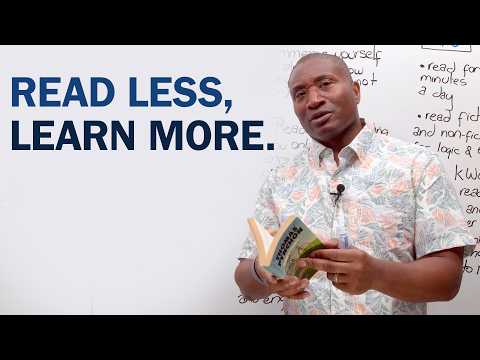
Does reading feel useless for you? I’ll show you how to fix that. Learn the difference between *active* and *passive reading* and discover practical techniques that help you remember more, understand faster, and actually learn from what you read. I explain why simply recognising words is not learning, and how encoding information makes it stick in your memory. You’ll learn how to immerse yourself in a text, forget what you think you already know, and start thinking the way the author thinks. I also cover practical habits like writing in books, asking your own questions, using *KWL* before reading, and choosing both fiction and non-fiction to develop emotional and logical understanding. These techniques turn reading into one of the most powerful tools you have for learning English (or anything else) faster. https://www.engvid.com/learn-faster-by-reading-actively/
The next video in this series: https://youtu.be/D6nvyilkTF0
Watch the whole series: https://www.youtube.com/playlist?list=PL1MxVBsQo85qLby7rrLVVLNlWMLYoLjJZ
In this lesson:
0:00 Reading is not what you think
0:56 Passive Reading vs. Active Reading
3:08 Reading is decoding.
4:59 Use the KWL method.
7:13 Mark up your books!
8:47 Reading gives you time to think.
10:24 Play soccer with a book.
13:30 Tip #1
14:09 Tip #2
15:32 Tip #3
16:31 Synoptic Reading
Transcript:
Hey. Hi, E. Reading. Hi. James from engVid. I'm doing a four-part series on speaking, listening, reading, and writing, and it's... The series is basically "It's Not What You Think". In other words, I'm going to go behind and show you what's really happening when you're doing these things, and how, if you understand this, you can enhance your language learning and communication skills. Okay? So, let's go to the board and see what E has for us.
So, he said reading is 15-20%. This is true. We spend most of our time speaking or listening, but you might be surprised by how much time we spend reading. And if you stop and think about it, you're reading almost all the time. You're on the subway, there are signs, you turn on your television, you read what the weather is, so it's more than you think, and it has an important impact on your ability to learn. All right? Because you can make yourself learn faster by reading. Let's go to the board and figure out how that works. All right?
So, most people, when they read, they just look at words. You know? You see them reading, and they do this. And as long as most of the words are words they've seen before, they thought, "I've read the page." But you can ask them five minutes later, "What did you read?" and they'll honestly go, "I don't remember", and they shouldn't. They looked at the words as they would look at a picture. They looked at it, I see the picture, but when I put this away, I can't remember if the baby was crying and his eyes went to the left or right, I just know there's a baby. I'm getting the basic idea and losing a lot of information. And that's how a lot of people read, and that's why a lot of them say that reading is useless, it's no good, blah, blah, blah, and they don't understand why someone can read a book and change their entire life, they can read the same book and get nothing from it. All right? I want to help you change that right now. And what we're going to do that is teach you to go from passive reading to active reading.
When we actively read, we immerse ourselves. For some of you, you might go, "What is immerse?" It's like going into a pool, right? Unless you're Jesus from 2,000 years ago, when you go in the pool, you don't walk on water. Right? You jump, you go in the water. And the deeper you go, the more, you know... Sorry. The more restriction, the harder it is to swim, but the more fun it is to swim. Right? So, when we actively read, we immerse ourselves. We get into it. If it's fiction, you try and get into the minds of the characters. If it's factual, you try to understand what the idea the person is trying to get to you. And by doing that and forgetting yourself, you start thinking like the author, and when you do that, you understand how they understand. And that's powerful. All right?
Now, here's a little note that I put underneath this, because some people, when they read... Hell, even when they do conversation, we've got one on that. Right? And they already know. And if you already know something, you can't learn something, because you already know. So, when you immerse yourself, you have to forget yourself and what you know in order to let new information come to you, because you might see it in a different way. And that leads to growth. Learning. Right?
So, reading is decoding. What is decoding? Well, in nature, because we are from nature, we were never designed for this. What do you mean we weren't? We can read. No, you weren't designed for this. 10,000 years ago, people weren't walking by trees, and it said "tree", and you go "tree", it said "tree". […]