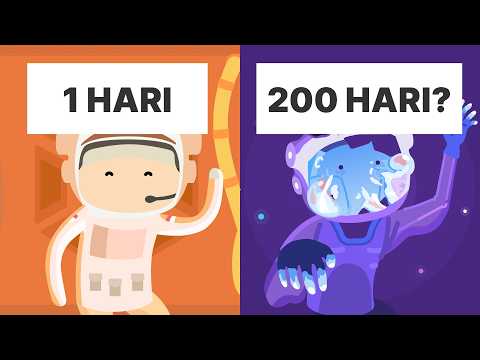
Sunyi… dan takut. Yang keliatan cuma hitam dan gelap. Jadi, apa rasanya terjebak di luar angkasa?
---
Tanyakan pertanyaan aneh anda di sini! NGGA ada pertanyaan yang bodoh! 'Kok Bisa' ngga cuma sekedar mencoba menjawab pertanyaan-pertanyaan yang terlihat bodoh, aneh dan dungu di sini, tapi juga mencoba menumbuhkan rasa keingintahuan anda terhadap segala hal di dunia ini. Jadi, tunggu apalagi? Ayo subscribe, let's watch the videos and go curiosity!
---
FAQ (Frequently Asked Questions):
Q: Min, upload tiap hari apa?
A: Tiap hari Rabu dan Sabtu. Tapi kadang-kadang ada video yang butuh waktu pembuatan lebih lama. So, stay tuned!
Q: Min, animasinya pake software apa?
A: Adobe After Effects
Q: MIN, KENAPA DI VIDEONYA ADA BAKSONYA TERUS!?
A: Bakso is inspiration *wink
---
? Follow Kok Bisa
Website: https://kokbisa.id (? artikel mendalam seru tiap 2 minggu)
Discord: https://www.kokbisa.id/discord (? ngobrol seru sesama pencinta sains)
Instagram: https://instagram.com/kokbisa (?️ infografik baru tiap hari)
TikTok: https://www.tiktok.com/@kokbisachannel (? video singkat seru)
Twitter: https://twitter.com/kokbisachannel (? diskusi di space tiap 2 minggu)
---
For business inquiries:
[email protected]
---
References:
Ashton, J. (2005, August 16). Cosmonaut clocks up record time in space. New Scientist.
Berkowitz, M. (2012). Research and diplomacy 350 kilometers above Earth. Science & Diplomacy.
D’Aunno, D. S., Thomason, D. B., & Booth, F. W. (1990). Centrifugal intensity and body size as determinants of muscle responses to hypogravity. Medical Hypotheses, 33(2), 107–111.
ESA Space Environment Report 2025. (2025). https://www.esa.int/Space_Safety/Space_Debris/ESA_Space_Environment_Report_2025
European Space Agency. (n.i.). International Space Station legal framework. https://www.esa.int/Science_Exploration/Human_and_Robotic_Exploration/International_Space_Station/International_Space_Station_legal_framework
European Space Agency. (n.i.). Mir FAQs - About the re-entry. https://www.esa.int/About_Us/Corporate_news/Mir_FAQs_-_About_the_re-entry
Frantz, G. (2024, June 6). Sergei Krikalev: A cosmonaut left stranded in space when the Soviet Union collapsed. IFLScience.
Garrett-Bakelman, F. E., Darshi, M., Green, S. J., Gur, R. C., Lin, L., Macias, B. R., ... & Turek, F. W. (2019). The NASA Twins Study: A multidimensional analysis of a year-long human spaceflight. Science, 364(6436).
Glaser, V. (2024, May 13). The astronaut who returned to a country that no longer existed: Sergei Krikalev's unbelievable 10-month mission in space. The Times of India.
Gorman, J. (n.d.). The last Soviet citizen cosmonaut. GW2RU. https://www.gw2ru.com/history/59196-last-soviet-citizen-cosmonaut
Growing plants in space - NASA. (n.d.). NASA. https://www.nasa.gov/exploration-research-and-technology/growing-plants-in-space/
Loff, S. (2020, May 15). About the NASA Twins Study. NASA. https://www.nasa.gov/humans-in-space/twins-study/about/
McPhee, J. C., & Charles, J. B. (Eds.). (2008). Human health and performance risks of space exploration missions. NASA.
NASA. (n.i.). 25 years of space station technology driving exploration. https://www.nasa.gov/centers-and-facilities/johnson/25-years-of-space-station-technology-driving-exploration/
NASA. (n.i.). International Space Station international cooperation. https://www.nasa.gov/international-space-station/space-station-international-cooperation/
National Space Centre. (n.i.). Who owns space? https://www.spacecentre.co.uk/news/space-now-blog/who-owns-space/
Niu, Y., Zhang, S., Gu, J., Lin, Z., Tang, C., & Li, Y. (2024). The physiological and psychological effects of long-duration spaceflight on humans. Frontiers in Physiology, 15.
Pappas, S. (2022, April 14). What happens to the human body in a vacuum? Live Science. https://www.livescience.com/human-body-no-spacesuit
Scientific American. (2000, February 21). Survival in space unprotected is possible—briefly.
Space Foundation. (n.i.). International space law. https://www.spacefoundation.org/space_brief/international-space-law/
Vernikos, J. (2009). Space medicine: The next frontier. The Lancet, 373(9681), 2111–2112.
Wallis, C. (2013, April 1). Astronauts get taller in space. Scientific American.
White, R. J., & Averner, M. (2001). Humans in space. Nature, 409(6823), 1115–1118.
Williams, D., Kuipers, A., Mukai, C., & Thirsk, R. (2009). Acclimation during space flight: Effects on human physiology. CMAJ: Canadian Medical Association Journal, 180(13), 1317–1323.
---
A massive THANK YOU to everyone for watching this and for all of your support!