影片說明
Get FREE 2-week access to smarter fat-loss training with the BWS+ app: https://bws.plus/e1
FFMI calculator:
https://builtwithscience.com/ffmi
Subscribe for more videos:
https://www.youtube.com/jeremyethier/?sub_confirmation=1
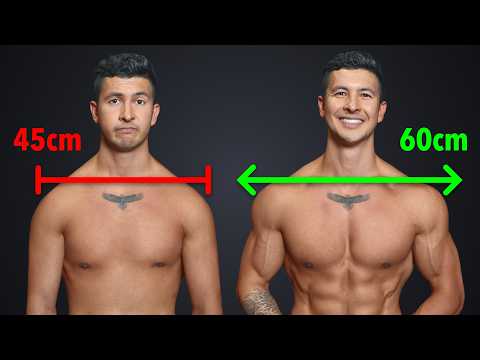
At 15, BEFORE he even touched a weight, his arms were bigger than most grown men. What if I told you this guy eats less than 1,500 calories a day, and yet is able to build muscle at an unheard of speed? Meanwhile, this was me. Narrow shoulders, skinny frame — I looked like a stick you’d find in your backyard. So, I dug into science to find a way to beat my crappy muscle genetics and muscle growth rate, and I finally transformed my body. How?
Well, there are 3 main ways genetics affect your muscles: How fast they grow. Which ones grow the fastest. And your natural limit. Let’s start with speed. Some people are genetically wired to grow muscle faster than the rest of us. Imagine you took 287 people and you had all of them do the exact same full-body workout twice a week for 6 months. Back in 2016, a group of scientists did just that, but used MRIs, Dexa scans, and ultrasound to measure muscle growth as accurately as possible.
Researchers noticed 3 types of muscle genetics. Hyperresponders. These people grew 2-3x faster than the average, growing their muscles up to 30% bigger. Average responders. This is where most people fell under. Growing their muscles by about 5-10%. Low-responders. Who barely built any muscle, with some even losing muscle! Remember, this was with the exact same training routine.
But what exactly in our muscle genetics is causing this? A possibility is myostatin, which inhibits muscle growth. What happens when you remove it? Well, a Belgian breed of cattle is actually born without myostatin, and they get abnormally massive as a result. But in humans, the first case of a human mutation in the Myostatin gene was first documented in a 2004 study, where a German newborn was pretty much jacked right out of the womb. However, this mutation is actually extremely rare; in every one million people, 4 might have it. What it does tell us, though, is that muscle genetics can have a huge impact on how much muscle you build and how quickly.
How can you tell if your genetics are good or bad in the first place? Look at how quickly you gained muscle and strength in your first year of training. But if you’re a low or average responder like me, are you stuck there forever? Not even close. You can absolutely speed up your progress and get way more out of your genetics than you think.
The first strategy for getting more out of your muscle genetics is training volume. But does ‘more is better’ apply to everyone? Well, Eric recently co-authored a one-of-a-kind study that suggests if you’re a low responder, you can potentially match the gains of a higher responder by simply doing more. But — and this is important — how much more depends on where you’re starting from. If you’re doing under 12 sets per muscle per week, this is where you’ll see the biggest benefit. If you’re in the 12 to 20 set range, the returns are smaller.
If you can only build so much muscle each year, and only recover from so much volume, the smartest move is to spend that ‘volume budget’ where it makes the biggest visual impact. From there, start those focus muscles at around 10 sets per week, trained at least twice a week. Then, slowly add about 2 sets per week until you’re up around 20 to 30 sets. Keep your other muscles at about 8 to 12 sets per week.
But if you just crank up the volume and train smarter, does that mean everyone, no matter their muscle genetics, can look like The Rock? Not quite. The last piece of your genetic story is your natural limit. And the best way to measure it is with something called the Fat Free Mass Index or FFMI. But how high can you push this?
Let’s start with the average person, who, before lifting, usually has a fat-free mass index of 19. Here you can expect to gain about 8-10 lbs of muscle in your first year of lifting, about 5 lbs in year two, and then less and less each year onwards. Eventually maxing out at a fat-free mass index of 22 to 23. Now, a low responder? You gain about half as much. Capping you at an FFMI of 20 to 21. And then of course, you’ve got steroid users. Dr. Mike Israetel — who’s open about being enhanced — shared his DEXA scan with me, and I calculated his fat-free mass index score at a whopping 35, breaking the scale.
Here’s the encouraging part: being lean makes you look way more jacked. Take Bruce Lee, or Brad Pitt in Fight Club. Both fall right into the 20 to 21 range, but have the athletic, lean physiques most guys would kill for. But here’s the problem: most people still never get close to even that level. And it’s usually not your genetics holding you back. Instead, it’s usually down to things you can control: sleep, nutrition, and training effort. So before you blame your genetics, commit to training and eating as if they don’t suck.