影片說明
Get FREE 2-week access to smarter training with the BWS+ app:
https://bws.plus/g1
Click below to subscribe for more videos:
https://www.youtube.com/jeremyethier/?sub_confirmation=1
How much protein to build muscle? Do you expect your muscles to grow bigger and bigger by shoveling more protein into your body? What if a high protein intake isn’t just unnecessary — but actually makes muscle building harder? In this video, I walk you through new research that challenges what we thought we knew about protein intake to build muscle, exposes the protein hype, and reveals the two things that reliably build more muscle than simply piling on extra protein.
What does protein do? When you lift, you trigger muscle protein synthesis. Protein supplies the bricks that let your body act on that signal. But somewhere along the way, “more bricks = bigger house” turned into an iron law. From golden-era stories of 300–400 g/day to today’s protein cereals, chips, cookies, and “extra protein” lattes, it’s easy to assume more is always better.
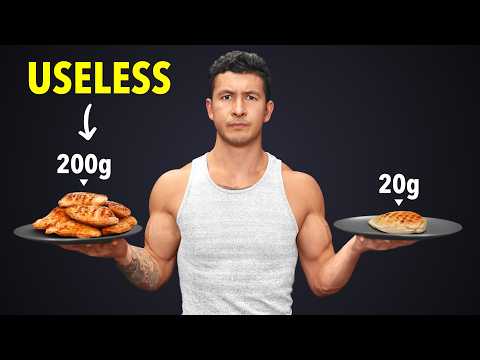
So, how much protein? Is more better? A group of top protein researchers gathered 62 long-term resistance-training studies and charted protein intake against actual growth. The surprise: the overall trend was basically flat. Doubling protein didn’t double gains. In one study, lifters on what most would call “low protein” grew about the same as lifters eating twice as much. In another, lifters eating roughly three times more protein actually gained less muscle. If you’re asking how much protein to build muscle, the data suggest that “more” isn’t automatically “better,” especially once you’re past a sensible, moderate intake.
As Dr. Eric Trexler explains, having more bricks than the blueprint calls for doesn’t give you a bigger house — you just have leftovers to haul away. It’s a useful way to think about protein intake for muscle building: enough bricks to build the house, not a mountain of unused materials that add cost and effort without improving the result.
What about protein type? Natural pro bodybuilder Alex Leonidas cut his intake roughly in half and switched to plant-based sources — often around 90 g/day — with no hit to recovery, progressive overload, or strength. His training logs and on-camera lifts show consistency despite the lower intake. That doesn’t “prove” one universal number for optimal protein intake, but it challenges the belief that sky-high targets are mandatory for progress.
If the key question isn’t just how much protein intake to build muscle, then what matters most? Training quality: Without hard, progressive lifting, extra protein does nothing. With a solid program, even modest intake can still build muscle. Technique, effort, progression, and recovery habits usually explain far more of your gains than chasing another scoop. Total calories: In a classic experiment, lifters adding a 2,000-calorie carb-only shake made similar muscle gains to lifters adding a 2,000-calorie shake with protein. The extra calories — not the extra protein — drove the improvement. Flip the script and go into a steep deficit, and muscle loss becomes likely even when protein is high. This is why, when calculating how much protein to build muscle, you also have to look at energy balance and carb availability for performance.
Protein still has clear roles. Moving from very low intake to a reasonable moderate target supports growth and recovery. During a cut — especially when you’re already fairly lean — a higher protein target helps manage hunger and maintain muscle. And for adherence, some people simply enjoy eating protein-rich foods. A quick shake can be a convenient 30 g that helps you hit the day’s target without overthinking it.
There are times when protein can quietly work against your goals. Protein is filling and has a higher thermic cost, which can be a problem if you’re trying to eat enough to gain. High-protein choices can also cost more per calorie. And, if protein intake crowds out carbs and fats, you may compromise glycogen, training performance, or hormones. When planning how much protein to build muscle, remember you’re distributing a finite calorie budget.
So… how much protein to build muscle? For the majority of lifters, consuming 0.55 to 0.63 grams of protein per pound of body weight will already be close to maximizing their gains. Protein also “sneaks in” from foods you might overlook: bread, beans, potatoes, oats, peanut butter, mixed meals. Often, hitting the target is as simple as anchoring the day with one protein-rich meal and a shake, then letting regular meals do the rest. Now, if you want a little extra “insurance,” you can go to about 0.64 to 0.72 grams per pound. And lastly, if you’re dieting and below 15% body fat, OR you’re just someone who wants the reassurance that you’re definitely maximizing your gains, you can bump it up to 0.73 to 1 gram per pound of bodyweight.