影片說明
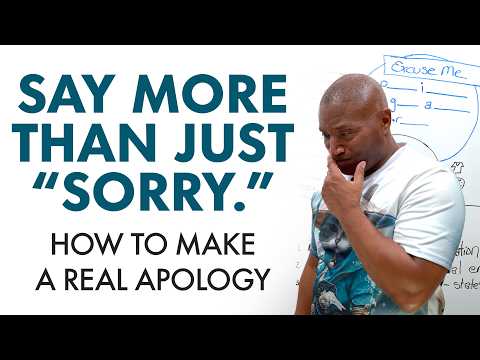
Do you know the difference between saying “sorry”, “excuse me”, “I regret”, and “I apologize”? Many English learners get these phrases wrong. In this lesson, I’ll teach you different ways to apologize in different context, so you can use the right one at the right time – in the right way! We’ll talk about how to say “sorry” in English for small mistakes, how to use “excuse me” for polite interruptions or to get attention, when to use “I apologize” in formal situations, and cover other useful phrases like “I regret”, “that was my fault”, and “my bad”. I’ll also share my secret 4-step formula for a real apology! https://www.engvid.com/say-sorry-the-right-way
Learn everyday conversational English:
Have Better Conversations: The S. E. A. Small Talk Method https://youtu.be/QjYZ1tTsvTA
5 questions to make you the most interesting person in the room https://youtu.be/hOXNssFPEnM
In this lesson:
0:00 Introduction
0:41 "Sorry"
2:25 "Excuse me"
4:40 "I apologize"
6:41 Other apology phrases
10:54 How to give a real apology
Transcript:
Doo-doo-doo, doo-doo-doo, oh, oh, sorry about that. Excuse me for a second, E. Listen, guys, I got to apologize. I just made a mistake and bumped into E. Today's lesson is on saying "sorry", or "I apologize", or "I"... Excuse me? Today I'm going to teach you the difference between each of these words, and when to use them, and how to use them properly. And as a bonus, I'll teach you a couple of other ones.
So let's go to the board and find out what the big deal about "sorry" is. As you can see, E is saying "sorry", "excuse me", and "I apologize", but should we always say them? Not necessarily. "Sorry" is a general word, so let's go over here. When we look at... Where am I? I'm sorry. "Sorry" is informal, that's why you hear it all the time. I'm sorry. Sorry? What was that? Sorry? It's informal. It's informal. So that means it can be used a lot of times in many different ways, because it's general. It's a general way to apologize, you hear it a lot. And inappropriately... "Inappropriate" means the wrong way, because people say "I'm sorry" when they really should say "Excuse me". Huh? Well, it's a catch-all, you can use it anywhere, but for example, if I'm about to interrupt you, "Sorry" is a bit strong, "Excuse me" would be better. But you can use it almost any time and you'll be okay, okay? That's why we like that. That's why you hear Canadians always say "I'm sorry", "Excuse me", "Thank you, we're so polite", right?
Now, the other good thing about "Sorry" is because it's informal and it's general, it has a place where it can go from minor to major. And you might say, "What the heck does minor to major mean?" See, look, informal t-shirt, it's kind of cool. Minor to major, minor is like little, like minor league. Well, you can say "I'm sorry" for something very small, like if I bump into you, "Oops, sorry", right? But at the same time, you can actually say something like "I'm sorry for hitting your car", and you might go "Well, those are big things", that's why you can use "Sorry" from minor to major things, and that's what makes it general and makes it, you know, a very good word to use. However, many people overuse it, so we talk about "Sorry" being informal, general, and minor to major, but sometimes it's a little heavy, a little too much, right? That's when we use "Excuse me". "Excuse me" is for things like when you know you're about to do something, but you haven't done it. You haven't done it. Imagine with "Sorry" you bump into someone, okay? You say "Sorry" because you've done something wrong, right? It's minor to major. But "Excuse me" is before you bump into them, you might say "Excuse me", and we call that a polite interruption, right? Because something is going on and you are interrupting or breaking into it, right? Okay? You know, you go "Excuse me, is anyone sitting here?" You're not going to say "Sorry, is anyone sitting there?" You're not sorry. You say "Excuse me" if people are there to interrupt them.
Another thing is you can use "Excuse me" to get someone's attention. "Excuse me, is there anybody working here? Excuse me, can you help me for a second?" You're not going to say "Sorry, can you help me?" "What are you sorry for? What did you do?" Nothing yet. Nothing yet. So, if you want to get my attention or anyone's attention, okay, say "Excuse me, excuse me for a second."
Now, also, "Excuse me" is for repeat, and you say "Repeat? I don't understand." Well, if someone's speaking to you and they're looking at you and you didn't hear it because maybe something - you're like - excuse me? What did you say? Okay? I'm asking you to repeat it because I wasn't paying attention. So it's a way of saying sorry, but I haven't done anything really wrong, so I don't want to say "Sorry", it's just "Excuse me, can you repeat that again?" […]