影片說明
? Our interactive news map: https://www.rfunews.com/map
? Subscribe to unlock full access to the map + exclusive strategic insights: https://www.rfunews.com/pricing
Today, there is dangerous news from Ukraine.
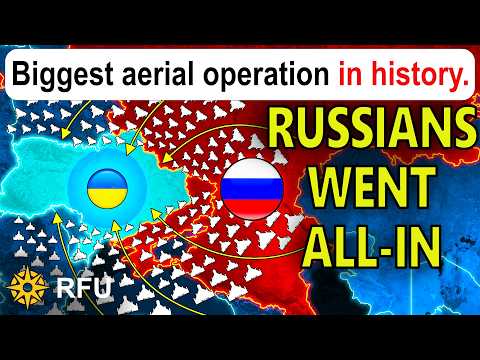
Here, the Russian Federation conducted the biggest single air raid in history with over 1,500 missiles and drones launched in a single night to destroy Ukraine’s logistics to starve off and collapse the frontline without supplies. What followed, however, shocked the Russian war planners and showed them how truly far they are from victory.
The most massive Russian attack in history began on May thirteen, when Russia started by launching almost nine hundred Shahed drones at once. The strikes were tightly focused on the western regions of the country to collapse key Ukrainian logistics nodes. Russia routed drones through Belarus and Moldova in an attempt to confuse Ukrainian air defense units by attacking from unexpected directions from the west or north, and not from east and south like usual. Russia relied primarily on conventional Shahed drones, while the number of rocket-propelled and guided variants remained relatively small, indicating that this attack was only meant as a saturation tactic to force Ukraine to exhaust its interception capacity on cheaper drones before the larger combined air strike designed to overwhelm Ukrainian air defenses.
After the initial wave, Russia immediately launched another six hundred and seventy-five Shahed and other drones to saturate Ukrainian defenses further. These drones were intended to clear a path for incoming missiles carrying much larger warheads. Russia then launched three Kinzhal ballistic missiles, eighteen Iskander ballistic missiles, and thirty-five Kha cruise missiles. The threat of additional Russian strikes remained high because Russia didn’t use Kalibr or Iskander-K cruise missiles in the latest attack, instead relying on strategic aviation and Iskander-M ballistic missiles. This shows that further missile launches are highly likely, as Russia still has enough missiles of other types.
Russia’s objective with this massive strike was to disrupt Ukrainian logistics in the western part of the country by striking transport links and railway infrastructure. These routes are critical because most Western military aid enters the country from Poland by rail, and by targeting this infrastructure, Russia aimed to sever Ukraine’s access to vital military supplies. The strikes also targeted Ukraine’s military-industrial complex, including air bases and related military infrastructure in western Ukraine, in an effort to reduce the country’s military production capacity. Fuel depots and other logistical facilities connected to the war effort were also attacked to slow the movement of war materials to the frontline and cause a collapse.
However, Russia not only struck military and logistical targets, but civilian ones as well, particularly in Kyiv, where residential buildings and civilian enterprises were hit. Especially notable was Russia’s use of the double-tap tactic, in which ballistic missiles struck the same locations again several hours after the initial attack to hurt Ukrainian rescue workers. Attacks also damaged port infrastructure in Odesa and energy facilities, including a gas pipeline in Dnipropetrovsk Oblast and infrastructure sites in the Kharkiv and Zhytomyr regions. Nationwide, more than one hundred and eighty sites were damaged, including over fifty residential buildings.
Despite the sheer scale of the Russian massive night attack, Ukraine still managed to shoot down ninety-four percent of the incoming drones and seventy-three percent of the missiles, virtually nullifying all Russian efforts. This makes the operation one of its most successful air defense efforts of the war, even though the scale and missile compositions of the attack were remarkable. Interceptor drones accounted for roughly thirty percent of all UAV kills, highlighting their growing role as a cost-effective tool compared to missiles. Three individual units were responsible for over two hundred drone shootdowns combined, using Sting interceptor drones, including one unit that destroyed one hundred and twenty targets by itself, setting a new record and playing a key role in preventing collapse in logistics, and completely shutting down the Russian attack. The remaining drones were engaged by electronic warfare systems and mobile fire groups, which also successfully neutralized hundreds of Shaheds.
Russians bet on the fact that Ukraine has a problem with ballistic missiles because it currently operates only between six and ten Patriot air defense batteries, which are the only reliable defense against ballistic missiles, and interceptor missile shortages remain severe. Despite these limitations, Ukrainian air defenses still managed to destroy two-thirds of the incoming ballistic missiles, while intercepting these remains difficult because of...